
How To Measure Threads and Seat Angles for Hydraulic Adapters
If you do need help identifying the right fitting or adapter for your application or as a replacement part, we do offer many different conversion tools (located at the top of our website), and cross reference for other manufacturer part numbers – simply search by your part number or give us a call to verify.
1. Measure Thread Diameter
To measure thread diameter, a combination of O.D./I.D. caliper should be used. Since the threads of a used fitting are prone to wearing and damage, these measurements may not be 100% accurate. A thread chart should be used to match measurements.
2. Determine the Number of Threads Per Inch / Millimeter per thread
In order to determine the number of threads per inch for Inch, and BSPP threads, a thread pitch gauge should be used. In the absence of a pitch gage, the distance between threads can be measured.
- Inch threads are designated in threads per inch.
- Measuring the distance between threads will identify metric thread pitch.
- When using a pitch gauge it should be placed on the threads until there is a snug fit.
3. Types of Measuring Tools
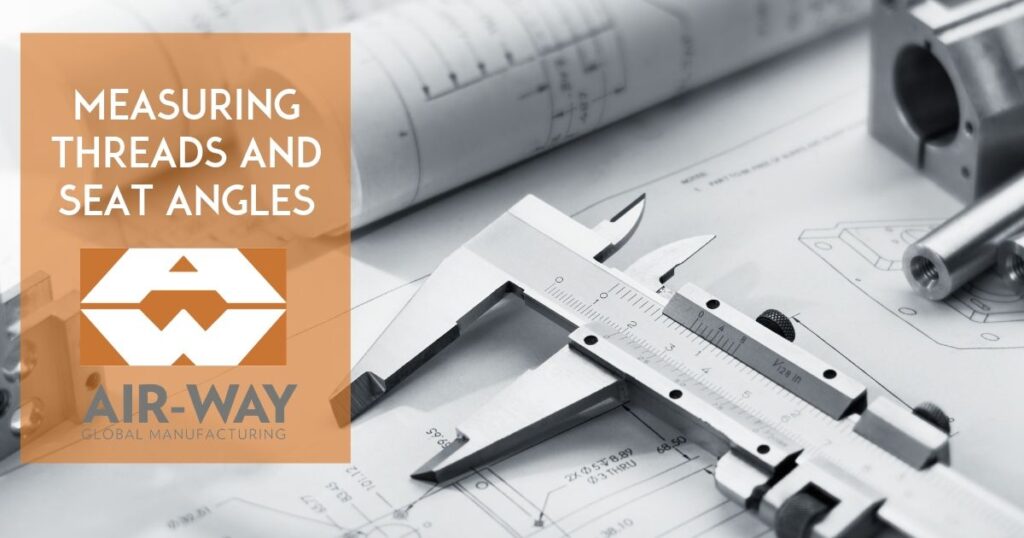
There are two tools that can be used to measure threads. These tools include an I.D./O.D. caliper (pictured above), and thread pitch gauge, which allow for optimal measurement accuracy.
4. How to Measure Sealing Surface (Seat) Angles
Female seats are very difficult to measure. For this reason, the manufacturer should be consulted. If you’re unsure, reach out to us today.
Male connections can be measured by placing a protractor gauge on the sealing surface while making sure that the connection and gauge are parallel to allow for correct angle identification.
Contact Air-Way Mfg for Assistance
For more information on how to measure threads, or if you’re looking for a replacement fitting or cross reference, please let us know by calling 800-253-1036 or reaching out online today.